Tk 30,000 Minimum Wage – How Can Bangladesh Ensure Fair Pay For Garment Workers?
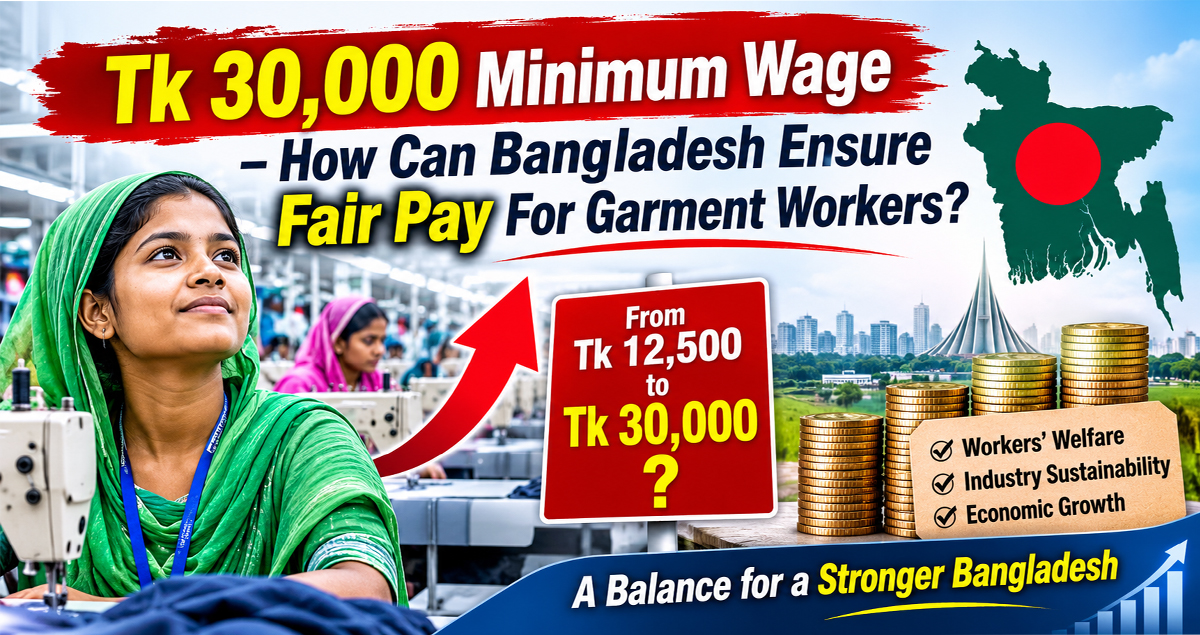
While it is true that garment workers in Bangladesh deserve fair pay, can the industry, which is already suffering from falling export rates and low profit margin be able to afford such a large 140% increase in minimum wage? This could affect the future of Bangladesh’s export economy.
There has been huge debate surrounding the calls to raise the minimum monthly wage of garment workers to Tk 30,000. With rising cost of living issues facing workers and increased production costs facing factory owners.
However, this issue affects the overall sustainability of the Bangladeshi economy.
Bangladesh’s Economy Reliance On RMG Sector
One of the most important sectors of Bangladesh is the Ready Made Garment sector. In FY2025-26, garment exports earned around USD 38.70 Billion for the country, contributing to over 80% of export earnings for merchandise.
The industry also employs around four million people directly and contributes to many linkages within the economy such as Textiles, Transport, Banking, Insurance & Logistics.
However, there is increasing pressure for this sector as garment exports dropped by around 1.64% in FY2025-26. International competition, energy shortages, increased production costs & poor global demand have all played a part.
This means that the debate regarding minimum wage can cause huge issues for this industry.
Can the Industry Afford a 140% Wage Increase?
The new minimum wage (Tk30,000) represents an increase of Tk17,500 for every worker. This represents a 140% increase from the current minimum wage.
Let’s do a simple calculation.
If all 4 million workers are paid this extra Tk17,500 then the industry will have to pay an extra:
4,000,000 x Tk 17,500 × 12 = Tk = 84,000 crore more in annual salaries.
This is at the higher end of the spectrum as not all workers earn the minimum wage currently. However, you can see how much money this would mean.
For the manufacturers this could impact their profitability as they will have to pay more. They could also have increased working capital needs and cash flow issues. Smaller and medium sized factories could face a bigger problem.
For the banking sector this could impact the ability to service debt, liquidity ratios and interest cover. Factories who rely on cash credit, overdrafts and trade financing could need additional working capital.
This could pose a risk to the bank if these issues continue as there could be increased overdue loans / NPLs.
The Real Problem: Low Value Addition and Weak Pricing Power
I believe that the main issue with Bangladesh is lack of pricing power. Bangladesh compete in the manufacturing space but most of the brand, design, marketing and distribution is controlled by international brands. Therefore a large amount of the final value can’t be added within the country.
Vietnam is a good example here. They have focused on increasing productivity, quality of products, technological innovation and higher value manufacturing. From looking at historical data from world bank we can see that Vietnam have higher garment exports per worker than Bangladesh.
You can see how international competitiveness isn’t just about having cheap labour. Productivity and value addition is just as important.
Bangladesh will need to slowly transition away from being a cheap manufacturing hub and will need to develop skills related to specialist fabrics, manmade fibres, design and higher value garments.
What Would Be the Impact on Bangladesh’s Economy?
An increase in wages can cause positive and negative impacts:
- Increased domestic consumption: As workers will have more money to spend they are likely to spend more on things such as food, housing, healthcare, education and other necessities. This can boost domestic demand and can therefore help small businesses grow.
- Inflation: As the manufacturers’ costs are increasing they may pass these costs onto consumers and this could cause inflation.
- Export competitiveness: If the factories are unable to increase their productivity or get a better price on their exports then international buyers may exports.move their orders to other competing countries. This will lead to a reduction in Bangladesh’s export earnings, foreign currency inflows and overall economic growth.
- Job losses: Factories that are struggling financially may reduce their staff or take longer to hire new staff.
- More risk in the banking sector: As the factories are making less profit from their operations it could affect their ability to pay back loans. This will create high tension for those manufacturers who are totally dependent on loans.
However it may create positive impact on employee retention, labor disputes and help productivity if salary is increased.
What Should Bangladesh do?
It would not be logical to increase the wage immediately without considering the capacity of industry or it should not be wise to leave the issue untouched now.
A balance must be found to ease this critical condition. Here different stakeholders can play following role to mitigate the issues-
- The government should consider increasing wages gradually based upon real living costs, inflation and industry productivity. International buyers should also take responsibility by paying fair sourcing prices.
- Manufacturers should invest in new technology, automation, energy efficient processes, staff development and managing production to improve productivity per staff member.
- Support should be provided to viable small and medium sized factories who are struggling with temporary cash flow issues. However, it shouldn’t be a permanent subsidy to inefficient businesses.
As Bangladesh has had an extension on their LDC graduation date (now November 2029) they have a great opportunity to improve their export competitiveness and negotiate better terms in the international market.
In my assessment, it isn’t just whether garment workers should earn Tk 30,000 but wages that allow them to live a reasonable standard of life.
The real issue is whether Bangladesh can develop an industry that pays more competitive wages.
However, a country can only rely on low wages within their export driven economy for so long. Without increasing productivity, adding value and gaining higher prices, raising wages could negatively affect the industry which gives millions of people jobs.
Bangladesh must develop their industry from low cost to high value. In the long run it shouldn’t be a choice between workers and sustainable industry, but to develop an economy where a strong financial industry leads to financially secure workers.
This is the true test of Bangladesh’s economic transformation.